Glass fiber reinforced plastic (GFRP) sculpture and its production process
The application of fiberglass sculptures in landscape architecture is becoming increasingly widespread. Here, we summarize relevant knowledge for sharing.
Glass fiber reinforced plastic, abbreviated as FRP, is also known as glass fiber reinforced composite plastic. It is primarily composed of glass fiber reinforcement, unsaturated polyester, epoxy resin, and phenolic resin adhesive. Due to the different types of resins used, it is referred to as polyester glass fiber reinforced plastic, epoxy glass fiber reinforced plastic, and phenolic glass fiber reinforced plastic. In China, it is commonly called glass fiber reinforced plastic. The characteristics of glass fiber reinforced plastic include light weight, hardness, non-conductivity, high mechanical strength, low recycling, easy molding, easy coloring, and the ability to be made into various shapes. It is also easy to paint. With a long service life of up to ten years, it can withstand wind and rain all year round. However, after five years, it may deform and partially crack. However, glass fiber reinforced plastic products also have their disadvantages, such as brittleness, susceptibility to damage, fracture, and corrosion. Therefore, glass fiber reinforced plastic products should be handled with care during use and transportation to avoid knocks and scratches.
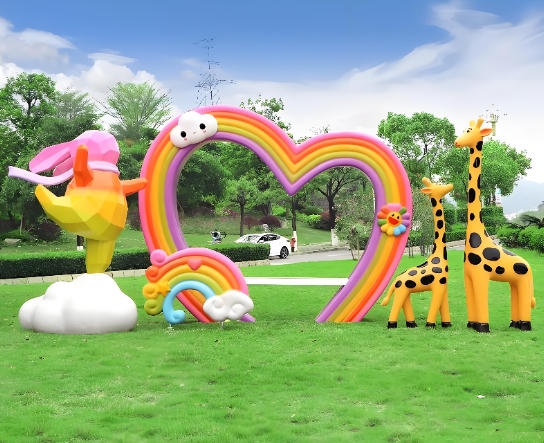
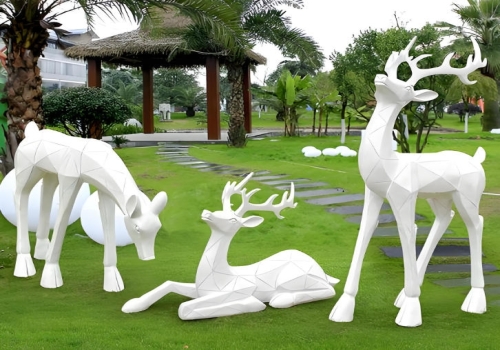
The most commonly used elements in garden landscapes are fiberglass sculptures, flower boxes, flower bowls, and vases, which can be seen everywhere. In particular, sculptures often serve as highlights in a park or a specific scenic area, often providing the finishing touch and serving as ideal backgrounds for group photos.
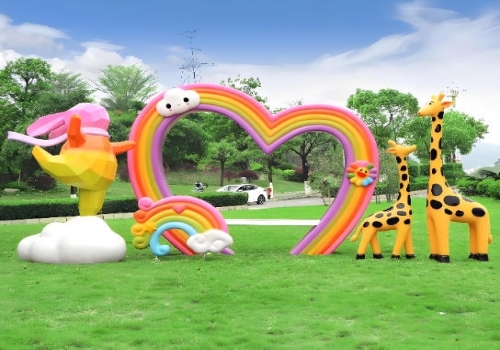
Due to its ease of molding, fiberglass can be crafted into a wide range of shapes as per requirements. Especially in scenic parks or residential areas, fiberglass sculptures are frequently employed, featuring novel designs and vivid forms. These sculptures can also be painted in a rainbow of colors, boasting vibrant hues and sleek lines, making them immensely popular among people.
The external color can be made into various colors, adjusted according to actual needs, and can also be made into various effects such as imitation copper and imitation gold.
The production process of fiberglass sculptures: First, design a good sculpture shape and meaning derived from the design. The designer needs to possess rich professional knowledge to design a sculpture into a vivid, lifelike, and meaningful work. Moreover, according to the requirements of the client, the designer should integrate the sculpture with the surrounding environment where it will be placed. Listen carefully to the client's opinions and requirements, record them in detail, fully understand and comprehend the client's intentions, so as to integrate and apply the client's ideas to the sculpture design. Before finalizing the design, communicate and confirm with the client repeatedly, and make modifications. After the design is finalized, design the production drawings, that is, the detailed drawings, which can be referred to and used as a basis for production.
II. Creating a Small Draft or Prototype This process is used for large sculptures. When creating molds for large sculptures, it is not feasible to achieve perfection in one step, as the cost of mold failure would be extremely high. Therefore, before creating the mold, a small draft or prototype is first made based on the design drawings. This involves creating a small model that undergoes repeated modifications until it matches the desired effect as per the drawings. Subsequently, a one-to-one mold is created by scaling up the small prototype.
The process of making fiberglass sculpture molds is a meticulous task. The quality of the mold directly affects the quality of the sculpture, making it an important part of the fiberglass sculpture production process.
There are two commonly used types of mold cores: one is clay mold core, and the other is foam mold core.
For sculptures that require strict craftsmanship and meticulous surface detailing, clay sculpting is used. This involves adhering clay to a mold, repeatedly refining the clay, and allowing it to dry naturally.
For sculptures with simpler production processes, foam molds are used. The surface of molds made from foam molds is not as smooth as that of molds made from clay sculptures, making post-processing more labor-intensive.
Mold pouring or mold flipping: It involves attaching silicone rubber to the mold base. Silicone rubber is soluble and water-dispersible, with good filling and flow properties. After the silicone rubber is crosslinked, that is, after it dries, the mold and mold base are separated.

For small fiberglass sculpture molds, the mold is split into two halves, creating a two-part mold. For large fiberglass sculptures, the mold is divided into multiple mold pieces.
Mold repair: After pouring or flipping the mold, carefully inspect whether the lines inside the mold cavity are smooth, whether the details are fully filled, and whether there are any issues such as mold sticking or incomplete filling. Any defective parts should be filled, polished, and repaired.
Fourth, the molding process of molded fiberglass sculptures is primitive, utilizing the hand lay-up technique. It appears simple, but in reality, it is complex. There are no technical parameters to guide the hand lay-up process, which relies primarily on experience and hand feel. The thickness is determined based on the size of the sculpture, the force it will bear, and the requirements of the client. The raw materials for the sculpture are filled into the mold cavity through hand lay-up. After they are basically dry, the sculpture is removed from the mold, and then the individual pieces of the sculpture are spliced and glued according to their numbers. After gluing and molding, the sculpture body is formed.
5. For tire repair and polishing, according to the lines and roundness required by the drawings, the tire body should be repaired first. Repair and polish simultaneously, and continue to do so until it fully meets the production requirements of the drawings. Then, clean the dust off the tire body and wait for painting and coloring.
Sixth, coloring, also known as painting the sculpture, is like dressing it up in a gorgeous coat. The first step is to clean the base. Cleaning it thoroughly makes it easier to paint. After cleaning, a primer is applied. Once the primer dries, the topcoat is applied and various patterns are drawn.
7. Packaging, Transportation, and Installation: After the paint is fully dry, it comes to packaging. Regardless of the distance of transportation, frames are required for sculptures to prevent damage during handling. Different transportation methods are chosen based on the quantity and volume of sculptures.
Installation: Depending on the actual situation of the sculpture, large-scale and high-altitude installations require professional installation by the manufacturer, while small-scale and surface placements can be installed under the guidance of professionals.